

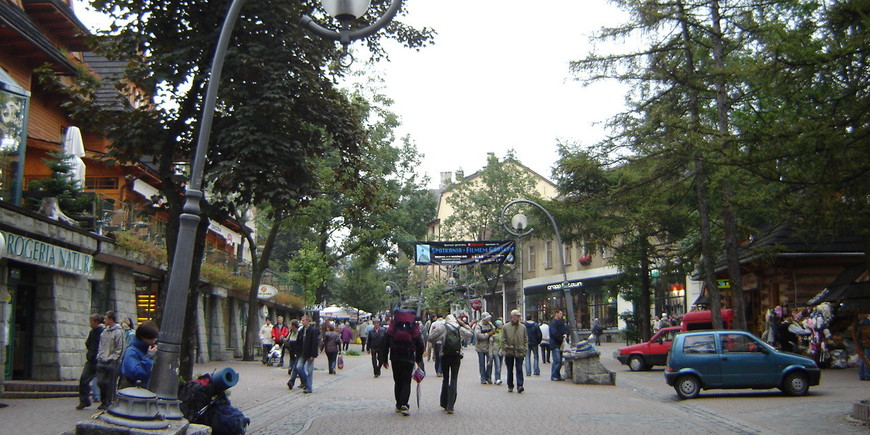
Infamous for kitsch and crowds, Krupówki street has long fallen victim to its success, with the phrase “crowded like Krupówki” a well-established Polish household saying. Hated as it might be around Poland, it’s basically unavoidable while you're in Zakopane, and - for better or worse - functions as the heart of the city. Along this 1.1 km-long street you’ll find many of the town’s most recognizable landmarks, including the Church of the Holy Family, Dworzec Tatrzański, and the Tatra Museum, while the atrocious post-modernist bank building at number 71 has garnered our attention - and perhaps no one else’s - solely due to its striking similarity to our ‘ironic favourite’ (cue hipster moustache twirl) in Wrocław, the Solpol shopping centre. You’ll also find endless mediocre waffles, shitty kebab and pizza joints, broke college students offering photo ops dressed as Winnie the Pooh, mass-manufactured shepherd's axes, made-in-China mugs, samurai swords, African masks, and various other gimcracks which would have made Zakopane’s 19th-century intellectualist residents shudder in horror.
Krupówki took on an official street character in the late 19th century, connecting the ironworks in Kuźnice with the newly built St. Mary of Częstochowa Church. For years before that, it was nothing but a path running through old-growth forest and meadows, including the Krupówka meadow that eventually gave the street its name. Cottages started popping up sparsely along the road around 1850, with locals building larger homes to rent out rooms to city folk, but it wasn’t until the 1880s that construction really took off. Newcomers from Kraków and Warsaw saw what was then the ‘Way to Kuźnice’ as prime real estate and started building a succession of houses in the very fashionable Swiss chalet style. Those included Dworzec Tatrzański, Tytus Chałubiński’s home, a woodcarving school, two hotels, and Zakopane’s first summer residence, belonging to Walery Eljasz, a realist painter, photographer, and guidebook writer (wink) from Kraków. In the 1890s the newly created Zakopane style became the norm, as construction continued; with locals following suit, soon Krupówki was densely built up with wooden structures. This unfortunately posed quite the fire hazard; following a rather disastrous 1899 fire, decisions were made to switch to more durable materials, which could finally be transported to the town via a new rail connection. The look of the street changed considerably during WWII, as the Nazis carried out the so-called Ordnungsaktion (“cleansing action”), taking apart many older homes. Today the street’s architecture is a mix of 19th century wooden villas, eclectic stone houses, and the odd commie-style or postmodernist carbuncle.
As you stroll southeast along Krupówki from its beginning at ul. Kościeliska, you will pass the following points of interest:
Krupówki 1 - the former Hotel Pod Gewontem, Zakopane's first hotel
Krupówki 1a - the Church of the Holy Family
On the right behind the small Foluszowski Stream, a succession of "pseudoregional huts," as a Polish guidebook so charmingly called them, selling assorted touristy knick-knacks
Krupówki 10 - the Tytus Chałubiński Tatra Museum
Krupówki 8 - a former woodcutting school, built 1876 (to find it, turn right at the Tatra Museum and look behind the huts)
Krupówki 12 - Dworzec Tatrzański
Krupówki 20 - 1905 post office
Krupówki 22 - one of those commie carbuncles we were talking about, the 1970 PBP Orbis house (originally built for a travel agency): what would have otherwise been a standard, drab block of flats was covered with a "tasteful" presudoregional wooden roof in a truly eye-offending combination. In more recent times insult was added to insult by slapping a huge banner on the side of the building
Krupówki 26 - a true landmark, this wacky postmodernist McD's makes us feel even worse about the state of this street
Krupówki 29 - continuing with offensive architecture, the curved, in-your-face facade of this building leads to a shopping mall, opened in 2001
Krupówki 28, 30, 39 - clustered together, these are the tree oldest brick houses on Krupówki, all dating back to 1900. The one at no. 30 is the famous Morskie Oko building, originally a hotel and wildly popular hangout for artists and writers, featuring a ball room and performance hall; no. 28, the Samuel Leistein house, was originally the Central Hotel
intersection with ul. Staszica and ul. Piłsudskiego - a sculpture of a Góral reading the paper, smartphone temporarily abandoned; commissioned for the 20th anniversary of the Tygodnik Podhalański weekly paper
Krupówki 50 - Poraj, an 1887 Swiss-style villa, originally a guest house
Krupówki 77 - Ślimak Villa
Comments